Revenue Cycle Management for Modern Eye Care: How iTRUST Delivers Enterprise-Ready RCM
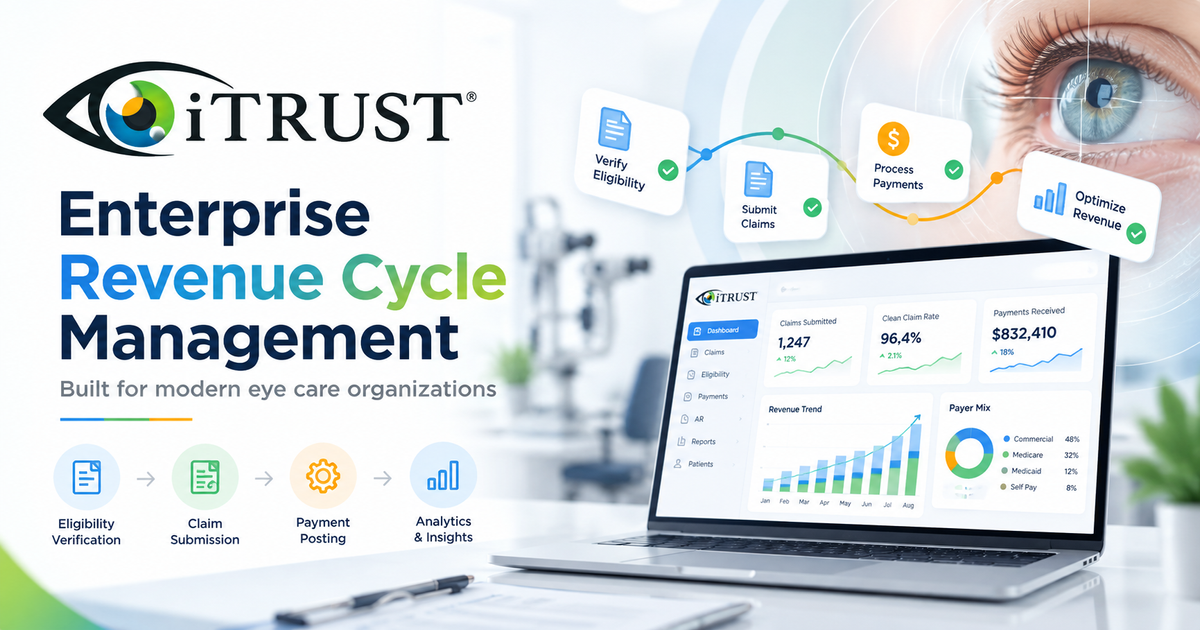
For an independent optometry practice, getting a claim from the exam room to the payer may seem straightforward.
For a growing eye-care organization operating 10, 30, 100 or 500+ locations, it is anything but.
Every patient encounter can trigger a chain of interconnected financial events: insurance verification, benefit determination, coding, charge capture, claim creation, clearinghouse transmission, payer adjudication, claim-status monitoring, electronic remittance, payment posting, adjustments, patient responsibility, denial management and financial reporting.
That entire process is the healthcare revenue cycle.
The Healthcare Financial Management Association defines revenue cycle management as the process healthcare organizations use to track revenue from the patient's initial encounter through the final payment of the balance.[1]
For enterprise eye-care organizations, however, revenue cycle management has become something even more important:
It is operational infrastructure.
When RCM is fragmented across an EHR, clearinghouse portal, spreadsheets, payer websites, separate billing applications and manual processes, growth creates complexity.
When RCM is integrated directly into the clinical and operational platform, growth can create leverage.
That is the philosophy behind iTRUST Revenue Cycle Management.
iTRUST brings clinical documentation, patient information, insurance, eligibility, claims, payments and financial workflows into a connected environment designed specifically for modern optometry and ophthalmology organizations.
The objective is simple:
Create one continuous workflow from appointment to payment.
What Is Revenue Cycle Management?
Revenue cycle management, commonly called RCM, includes the administrative and financial processes healthcare organizations use to receive payment for the services they provide.
The cycle does not begin when the claim is submitted.
It begins much earlier.
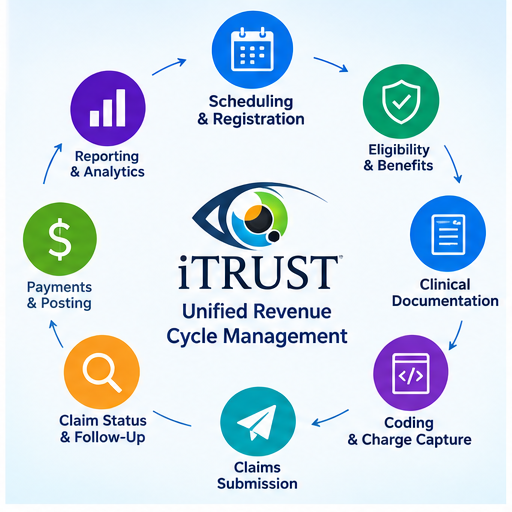
A typical revenue cycle may include:
- Patient scheduling
- Patient registration
- Insurance information collection
- Eligibility and benefit verification
- Prior authorization when required
- Clinical documentation
- Diagnosis and procedure coding
- Charge capture
- Claim generation
- Claim validation
- Electronic claim submission
- Clearinghouse processing
- Payer adjudication
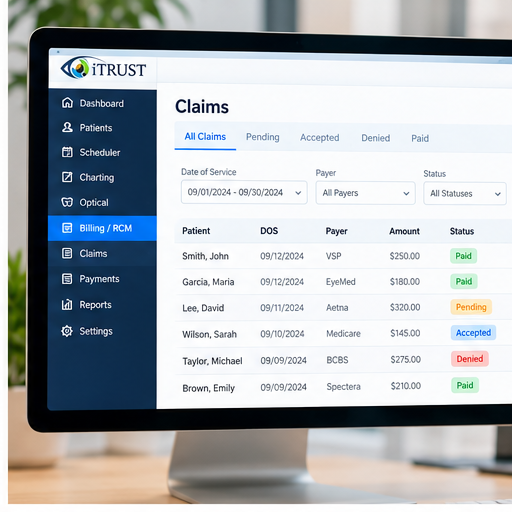
- Claim-status monitoring
- Electronic remittance processing
- Insurance payment posting
- Contractual adjustments
- Patient responsibility
- Denial or rejection follow-up
- Accounts receivable management
- Financial and operational reporting
Every step affects the next.
Incorrect demographic information can cause a claim rejection.
Incorrect insurance information can cause a denial.
Missing provider information can prevent successful claim processing.
Incorrect coding combinations can result in payment reductions or denials.
A payment can be received correctly but posted incorrectly.
A claim can even be adjudicated correctly while still creating an inaccurate accounts receivable balance if adjustments and patient responsibility are not handled properly.
That is why enterprise RCM cannot simply be treated as a billing department function.
It has to be connected to the entire patient and clinical workflow.
The Revenue Cycle Begins Before the Patient Is Seen
One of the most common misconceptions about RCM is that billing begins after the provider completes the encounter.
In reality, some of the most important revenue-cycle work happens before the examination ever starts.
Consider eligibility.
The healthcare industry uses standardized electronic transactions for eligibility and benefit inquiries.
A 270 transaction is generally used to request eligibility and benefit information, while the payer returns a 271 response containing coverage information.[2]
CMS operates this same model through its HIPAA Eligibility Transaction System and specifically describes the use of secure 270 requests and 271 responses to retrieve eligibility information.[2]
For an eye-care practice, the underlying question is straightforward:
Is this patient eligible for the services being provided, and what financial responsibility may apply?
At enterprise scale, however, answering that question manually becomes expensive.
Imagine an organization scheduling hundreds or thousands of appointments every day.
If employees must repeatedly:
- log into payer websites,
- call insurance companies,
- copy benefit information,
- re-enter deductible information,
- document copays,
- check effective dates,
- determine coverage,
- and manually update patient accounts,
the organization creates an enormous administrative workload before a single claim has even been generated.
The 2024 CAQH Index illustrates why automation matters.
CAQH estimated that healthcare automation already avoids approximately $222 billion in administrative costs annually, while another approximately $20 billion in annual savings could potentially be unlocked by moving remaining administrative workflows toward fully electronic processing.[3]
Eligibility verification and claim-status inquiries were specifically identified as areas with major automation opportunities.
That principle is fundamental to iTRUST RCM:
Revenue-cycle data should flow through the system instead of forcing employees to repeatedly retrieve, interpret and re-enter it.
From Clinical Documentation to a Clean Claim
After the patient encounter, clinical activity has to become structured billing information.
That transition is one of the most important points in the entire revenue cycle.
A claim must accurately connect information such as:
- patient demographics,
- subscriber information,
- insurance information,
- rendering provider,
- billing provider,
- referring provider when applicable,
- National Provider Identifier,
- place of service,
- date of service,
- diagnosis codes,
- procedure codes,
- modifiers,
- units,
- charges,
- authorization information,
- coordination of benefits,
- and payer-specific requirements.
Healthcare providers covered by HIPAA use the National Provider Identifier, or NPI, as the standardized provider identifier in HIPAA administrative and financial transactions.[4]
Diagnosis coding is similarly standardized.
The official ICD-10-CM guidelines are maintained through CMS and the National Center for Health Statistics and establish guidelines for coding diagnoses and reasons for healthcare encounters.[5]
Procedure coding creates another layer of complexity.
CMS maintains its National Correct Coding Initiative, commonly called NCCI, specifically to promote correct coding methodologies and reduce improper payments.[6]
Procedure-to-procedure edits can affect combinations of CPT/HCPCS codes reported together, while Medically Unlikely Edits address units of service.[7][8]
This demonstrates something important about enterprise RCM:
A claim is not simply an invoice. It is structured healthcare data.
And the quality of that structured data has a direct impact on reimbursement.
Why an Integrated EHR + RCM Model Matters
Traditional healthcare technology stacks often separate clinical and financial operations.
The provider documents the encounter in one application.
The front desk verifies insurance somewhere else.
Claims move through another application.
Employees visit clearinghouse portals to investigate rejected claims.
Payments appear in remittance files.
Accounting or billing staff then reconcile everything.
The result is often duplicated work and disconnected information.
iTRUST takes a fundamentally different approach.
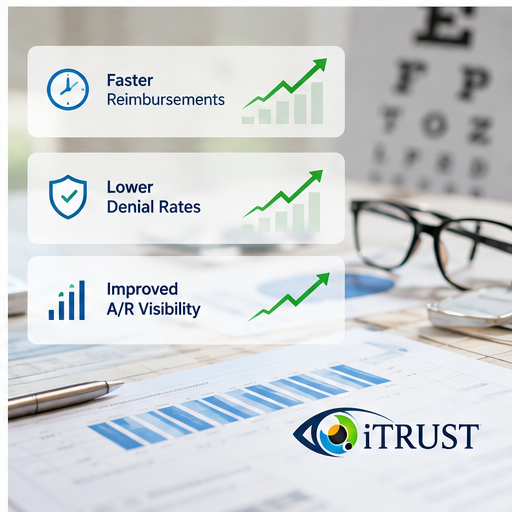
Because RCM exists alongside the EHR, scheduling, patient information and operational workflow, the system can maintain continuity from the original encounter through reimbursement.
Instead of thinking about an EHR and billing system as two separate products, the better model is:
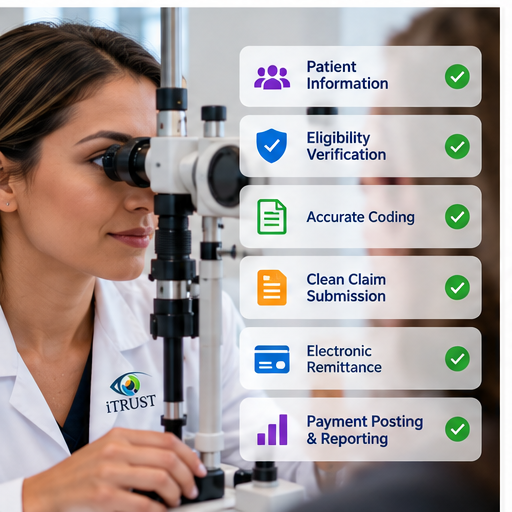
Patient → Appointment → Eligibility → Encounter → Coding → Claim → Adjudication → Payment → Reporting
That continuity becomes even more valuable as an organization grows.
The Office of the National Coordinator for Health Information Technology notes that electronic health records can improve workflow efficiency, coordination and access to information.[9]
ONC also emphasizes interoperability as an important part of modern healthcare, enabling electronic systems to exchange information across providers, patients, payers and other organizations.[10]
Enterprise software should apply that same philosophy internally.
The scheduling system should not exist independently from eligibility.
Eligibility should not exist independently from the patient record.
The patient record should not exist independently from the claim.
The claim should not exist independently from the payment.
And the payment should not exist independently from financial reporting.
The closer those workflows become, the less administrative fragmentation the organization has to manage.
Electronic Claims: Understanding the 837 Professional Workflow
Professional healthcare claims are commonly transmitted electronically using the X12 837 Professional transaction.
X12 identifies the 837 Professional transaction as the standard used to submit professional healthcare claims and encounters.[11]
For optometry and ophthalmology practices, this matters because the electronic claim must convert information stored inside the EHR and billing system into a highly structured transaction understood by the clearinghouse and payer.
The system must correctly represent numerous elements of the claim.
For example:
- Who received the service?
- Who holds the insurance policy?
- Which payer is responsible?
- Which provider rendered the service?
- Which organization is billing?
- Was another provider involved?
- What diagnoses support the encounter?
- Which services were performed?
- What amount was charged?
- Are modifiers required?
- Is another payer involved?
Enterprise organizations multiply that complexity because different locations may involve different combinations of:
- providers,
- NPIs,
- tax entities,
- payers,
- payer IDs,
- contracts,
- specialties,
- services,
- fee schedules,
- vision plans,
- medical plans,
- referral relationships,
- and operating procedures.
A scalable RCM platform must therefore be capable of managing complexity without requiring every location to reinvent its own billing process.
That is one of the defining characteristics of enterprise readiness.
Enterprise RCM Means Standardization Across Locations
There is a major difference between supporting multiple locations and being truly enterprise ready.
A multi-location system may simply allow users to create Location A, Location B and Location C.
An enterprise platform must help the organization manage those locations consistently.
Consider a 50-location eye-care group.
Without centralized workflows, 50 locations can gradually develop 50 different methods for:
- collecting insurance,
- verifying eligibility,
- handling vision benefits,
- documenting authorizations,
- entering charges,
- resolving rejected claims,
- processing patient balances,
- and escalating billing problems.
That creates operational risk.
An enterprise RCM platform should instead allow the organization to establish a repeatable financial workflow.
Corporate leadership can think globally.
Regional management can evaluate groups of locations.
Individual offices can execute their responsibilities locally.
The billing team can work across the organization.
And financial leadership can analyze performance across the enterprise.
That is the model iTRUST is designed to support.
Eye Care Requires More Than Generic Medical Billing
Optometry and ophthalmology present unique revenue-cycle challenges because many organizations operate across multiple reimbursement models simultaneously.
A patient encounter may involve:
- commercial medical insurance,
- Medicare,
- Medicaid,
- vision insurance,
- self-pay,
- optical benefits,
- contact lens benefits,
- materials,
- diagnostic procedures,
- or combinations of these.
That means eye-care organizations frequently have to determine not only whether a patient has coverage, but also which benefit should apply to which service.
For example, routine vision coverage and medical coverage may coexist.
An organization may also need to separate professional services from optical products and materials.
Those workflows become substantially more complicated in larger organizations.
That is why iTRUST's focus on optometry and ophthalmology matters.
The goal is not simply to reproduce generic medical billing functionality.
The goal is to connect RCM to how an eye-care organization actually operates.
Claim Status Should Be Data, Not a Phone Call
Submitting a claim is only the beginning.
Organizations also need to understand what happened after submission.
Traditionally, billing staff frequently checked payer portals or called insurance companies to determine whether a claim was:
- received,
- accepted,
- pending,
- processed,
- denied,
- rejected,
- or paid.
Electronic healthcare standards provide another option.
The healthcare industry uses 276 Claim Status Requests and 277 Claim Status Responses for electronic claim-status workflows.[12]
CMS specifically explains that electronic 276/277 transactions can reduce manual inquiries and allow status information to be posted electronically rather than requiring employees to manually check individual claims.[12]
This is exactly the type of workflow enterprise RCM should move toward.
Employees should spend less time asking:
“Where is this claim?”
And more time working exceptions that actually require human attention.
That is a much more scalable model.
Electronic Remittance and the 835
Eventually, a payer adjudicates a claim.
But receiving money is only part of the process.
The organization also needs to understand why the payer paid what it paid.
This is where the 835 Electronic Remittance Advice becomes extremely important.
X12 describes the 835 as the transaction used to communicate healthcare claim payment and remittance information.[13]
CMS explains that an Electronic Remittance Advice provides information regarding how a health plan processed a claim, including adjustments related to factors such as:
- contractual arrangements,
- secondary payers,
- benefit coverage,
- copays,
- and coinsurance.[14]
That information is essential for accurate accounts receivable.
If the original claim says $300 was billed and the payer sends $175, the system cannot simply record a $175 payment and leave $125 outstanding.
It has to determine what happened to the remaining amount.
Was it:
- a contractual adjustment?
- deductible?
- coinsurance?
- copayment?
- non-covered?
- denied?
- transferred to another payer?
- transferred to the patient?
This is why payment posting is not merely entering a check amount.
It is the process of reconstructing the payer's adjudication.
Automated Payment Posting Is a Major Enterprise Opportunity
Electronic remittance creates the opportunity to automate large portions of payment posting.
CMS explicitly notes that EFT and ERA workflows can help streamline manual processes, accelerate revenue cycles and support automatic posting of payments to accounts receivable.[14]
That becomes increasingly important as transaction volume grows.
At a single location, manually processing dozens of remittances may be inconvenient.
At an enterprise organization processing thousands or tens of thousands of claims, manual posting can become a substantial operating expense.
An integrated RCM platform can instead interpret electronic remittance information and use it to update the financial record.
That does not mean humans disappear from the process.
Exceptions will always exist.
The objective is to make exceptions the minority of the workflow instead of forcing staff to manually process every transaction.
This is a central concept behind iTRUST RCM:
Automate the predictable. Surface the exception.
Denial Management Is Really Exception Management
Every organization will experience denied and rejected claims.
The important question is how quickly those problems become visible and how efficiently they can be resolved.
A strong RCM platform should help the organization distinguish among different problems.
For example:
A rejection may occur before the claim reaches the payer because required information is missing or invalid.
A denial may occur after payer adjudication because the payer determined the service was not payable under the submitted circumstances.
Those are very different problems and may require very different responses.
Standardized remittance information helps organizations classify adjustments.
CMS notes that health plans use standardized Claim Adjustment Reason Codes (CARCs) and Remittance Advice Remark Codes (RARCs) to explain payment adjustments.[15]
This allows an enterprise RCM platform to move beyond simply showing:
Claim denied.
Instead, the objective should be to help users understand:
What happened? Why did it happen? What action is required?
That is the difference between displaying billing data and creating an operational workflow.
RCM Analytics Become More Valuable as an Organization Grows
One of the biggest advantages of an integrated enterprise platform is data visibility.
Executives should not need to ask every location for spreadsheets to understand the organization's financial performance.
An enterprise RCM platform can create visibility across dimensions such as:
- location,
- provider,
- payer,
- service,
- aging bucket,
- claim status,
- adjustment category,
- date of service,
- date of submission,
- date of payment,
- and patient responsibility.
That creates an opportunity to answer much more important questions.
Which locations are generating the highest collections?
Which offices have the largest unresolved receivables?
Which payers consistently take longer to reimburse?
Where are claim rejections occurring?
Are certain providers experiencing unusual denial patterns?
Are payments being posted consistently?
How much A/R is 0–30 days old?
How much is 31–60?
How much is 61–90?
How much is over 90?
Which problems are isolated incidents?
Which problems are systemic?
This is where RCM transitions from a billing tool into a management system.
Centralized RCM Can Change the Economics of Scale
Growth does not automatically create efficiency.
A 50-location organization can easily become 50 independent offices sharing the same logo.
The economic benefit of scale appears when the organization can centralize repetitive work.
RCM is one of the biggest opportunities.
Instead of requiring every office to independently maintain a complete billing operation, organizations can centralize functions such as:
- payer configuration,
- claim review,
- claim submission,
- rejection handling,
- insurance follow-up,
- payment posting,
- denial management,
- A/R management,
- and revenue-cycle reporting.
Local teams can focus on the patient.
Central teams can focus on reimbursement.
Technology connects the two.
CAQH's research reinforces the scale of the opportunity. Its 2024 analysis found billions of dollars of additional savings remain available through further automation of healthcare administrative transactions.[3]
The larger the organization, the more meaningful those efficiencies can become.
Enterprise Readiness Requires Interoperability
No enterprise healthcare platform exists completely by itself.
Organizations interact with:
- insurance companies,
- clearinghouses,
- pharmacies,
- laboratories,
- payment processors,
- hospitals,
- health information exchanges,
- analytics platforms,
- diagnostic systems,
- optical laboratories,
- and numerous other healthcare technology systems.
ONC describes interoperability as a foundational mechanism for securely exchanging electronic health information and improving coordinated care.[10]
The same principle applies to financial operations.
An enterprise RCM platform has to function inside a broader healthcare ecosystem.
That means embracing industry standards instead of creating isolated proprietary workflows.
iTRUST RCM is designed around those connections.
Eligibility can be exchanged electronically.
Professional claims can move through standardized claim workflows.
Claim status can be tracked.
Electronic remittance can return payer adjudication information.
Payments can be posted.
Financial information can then flow back into the patient account and organizational reporting.
It is a cycle—not a series of disconnected transactions.
The Industry Is Moving Toward More Automation, Not Less
Healthcare administration continues moving toward electronic exchange.
CMS operating rules establish requirements for transactions including eligibility, claim status, EFT and electronic remittance.[16]
CAQH CORE continues developing and updating operating rules intended to simplify and standardize healthcare payment and claims workflows.[17]
X12 continues developing newer versions of healthcare transaction standards, including:
- 835 payment/remittance,
- 837 claims,
- 276/277 claim status,
- and 270/271 eligibility transactions.[18]
The direction is clear.
The future of revenue-cycle operations is not employees logging into more portals.
It is structured data moving electronically between systems.
Enterprise technology has to be designed for that future.
Prior Authorization Is Becoming More Electronic Too
Prior authorization has historically been one of healthcare's most administratively intensive processes.
That is changing.
CMS's Interoperability and Prior Authorization Final Rule introduced requirements intended to improve electronic health-information exchange and streamline prior authorization processes for certain payers.[19]
The broader implication is significant.
Healthcare administration is increasingly becoming API-driven, standardized and interconnected.
That reinforces the importance of building RCM platforms on architecture capable of participating in a rapidly evolving electronic ecosystem.
Enterprise organizations selecting technology today should therefore consider not only what the system can do today, but whether the platform is designed to evolve with healthcare standards tomorrow.
Security and Privacy Cannot Be Separated From RCM
Revenue-cycle systems contain some of the most sensitive information in a healthcare organization.
They may process:
- patient names,
- addresses,
- dates of birth,
- diagnoses,
- insurance information,
- provider information,
- financial information,
- claims,
- payment information,
- and other protected health information.
The HIPAA Privacy Rule establishes national standards for protecting individually identifiable health information and applies to covered entities conducting certain healthcare transactions electronically.[20]
Enterprise RCM must therefore be approached as healthcare infrastructure—not as an ordinary accounting application.
Privacy, secure information exchange, access management and operational controls all become part of the revenue-cycle conversation.
Patient Financial Responsibility Is Part of RCM Too
Modern revenue cycle management does not end with insurance.
Patients increasingly participate directly in healthcare payment.
Deductibles, copayments, coinsurance, non-covered services and self-pay services can all create patient responsibility.
Healthcare organizations therefore need a financial workflow that clearly connects payer adjudication to the patient's remaining balance.
The issue has also received increasing regulatory attention.
Under federal No Surprises Act requirements, uninsured and certain self-pay patients may be entitled to receive a Good Faith Estimate of expected charges before scheduled care.[21]
That illustrates a broader trend:
Patient financial transparency is becoming part of healthcare operations.
A modern RCM platform must therefore think beyond claims.
It should help organizations understand the complete financial relationship between:
provider + payer + patient.
Why iTRUST RCM Is Built for Eye-Care Enterprises
iTRUST is not approaching revenue cycle management as an isolated billing product.
RCM sits within a broader eye-care platform that can connect:
- scheduling,
- patient registration,
- eligibility,
- clinical documentation,
- diagnosis and procedure information,
- claims,
- remittance,
- payments,
- patient balances,
- optical workflows,
- reporting,
- and multi-location operations.
That architecture becomes particularly important for enterprise organizations.
As an organization grows, the value of a unified platform does not increase linearly.
It compounds.
Every additional location that follows the same operational structure makes centralized processes more powerful.
Every additional claim processed through a standardized workflow increases the value of centralized reporting.
Every additional payer transaction handled electronically reduces the need for another manual workflow.
And every workflow consolidated into the platform reduces the number of separate systems employees must learn, maintain and reconcile.
A Better Way to Think About Enterprise RCM
The question should not simply be:
“Can your EHR submit a claim?”
Almost every modern billing platform can submit a claim.
The more important questions are:
Can your organization verify eligibility efficiently?
Can clinical information transition into billing without unnecessary re-entry?
Can you standardize billing workflows across dozens of locations?
Can you see what happened to a claim after it was submitted?
Can you automatically interpret remittance information?
Can you accurately post insurance payments and adjustments?
Can you identify exceptions quickly?
Can you manage payer-specific workflows?
Can you separate location-level performance from enterprise performance?
Can leadership understand the organization's revenue cycle without assembling spreadsheets from dozens of offices?
Can the platform scale when the organization doubles in size?
Can it participate in the electronic healthcare ecosystem?
Those are enterprise questions.
And those are the questions iTRUST RCM is built to address.
From Revenue Cycle Management to Revenue Cycle Intelligence
The next generation of healthcare RCM will not simply record financial events.
It will increasingly help organizations understand them.
The raw ingredients already exist:
eligibility information,
claims,
claim status,
payer responses,
remittance,
payments,
adjustments,
denials,
patient responsibility,
locations,
providers,
and time.
When those elements exist in disconnected systems, they create administrative work.
When they exist in a connected platform, they create intelligence.
An organization can begin identifying patterns instead of individual problems.
Instead of:
“Why did this claim deny?”
the organization can ask:
“Why is this payer denying this procedure across seven locations?”
Instead of:
“Has this patient paid?”
leadership can ask:
“How is patient A/R trending across the enterprise?”
Instead of:
“Where is this claim?”
management can ask:
“Where are claims getting delayed in our revenue cycle?”
That transition—from transactions to intelligence—is one of the most important opportunities in enterprise healthcare technology.
The Bottom Line
Revenue cycle management is ultimately about much more than collecting money.
It is the financial operating system behind healthcare delivery.
For modern optometry and ophthalmology organizations, that operating system has to handle an increasingly complicated combination of clinical data, insurance rules, vision benefits, medical payers, electronic transactions, payment information and patient responsibility.
Enterprise organizations cannot solve that complexity by simply adding more people.
They need better infrastructure.
iTRUST RCM is designed to bring the revenue cycle into the same connected environment as the rest of the practice.
From eligibility verification to claim generation.
From standardized electronic claims to payer adjudication.
From claim-status tracking to electronic remittance.
From insurance payments to accounts receivable.
From individual locations to enterprise-wide reporting.
The objective is not simply to help an organization submit claims.
The objective is to help the entire organization operate a better revenue cycle.
Because when clinical, operational and financial workflows finally work together, revenue cycle management stops being a back-office burden.
It becomes an enterprise advantage.
References
1. Healthcare Financial Management Association — Healthcare Revenue Cycle Management: What It Is & How It Works
HFMA Revenue Cycle Management Overview
2. Centers for Medicare & Medicaid Services — HIPAA Eligibility Transaction System / 270–271
CMS HIPAA Eligibility Transaction System
3. CAQH — 2024 CAQH Index: Healthcare Administrative Automation
CAQH 2024 Index Key Takeaways
4. Centers for Medicare & Medicaid Services — National Provider Identifier Standard
CMS National Provider Identifier Standard
5. CDC / National Center for Health Statistics — ICD-10-CM Official Guidelines for Coding and Reporting
Official ICD-10-CM Coding Guidelines
6. Centers for Medicare & Medicaid Services — National Correct Coding Initiative
CMS National Correct Coding Initiative
7. Centers for Medicare & Medicaid Services — NCCI Procedure-to-Procedure Edits
CMS Procedure-to-Procedure Edits
8. Centers for Medicare & Medicaid Services — Medically Unlikely Edits
CMS Medically Unlikely Edits
9. Office of the National Coordinator for Health IT — Benefits of Electronic Health Records
ONC Benefits of EHRs
10. Office of the National Coordinator for Health IT — Interoperability
ONC Interoperability Overview
11. X12 — Healthcare Transaction Flow and 837 Professional Claims
X12 Healthcare Transaction Flow
12. Centers for Medicare & Medicaid Services — 276/277 Claim Status Request and Response
CMS Claim Status Request and Response
13. X12 — 835 Healthcare Claim Payment and Remittance
X12 Transaction Sets
14. Centers for Medicare & Medicaid Services — EFT and Electronic Remittance Advice
CMS EFT and Remittance Advice
15. X12 — Claim Adjustment Reason Codes
X12 Claim Adjustment Reason Codes
16. Centers for Medicare & Medicaid Services — HIPAA Administrative Simplification Operating Rules
CMS Operating Rules Overview
17. CAQH CORE — Operating Rules for Healthcare Payments and Claims Processing
CAQH CORE Healthcare Payment Operating Rules
18. X12 — HIPAA Healthcare Transaction Standards Recommendations
X12 HIPAA Transaction Standards
19. Centers for Medicare & Medicaid Services — Interoperability and Prior Authorization Final Rule
CMS Interoperability and Prior Authorization Final Rule
20. U.S. Department of Health and Human Services — HIPAA Privacy Rule
HHS HIPAA Privacy Rule