Choosing the best optometry EHR software in 2026 means looking beyond electronic charting.
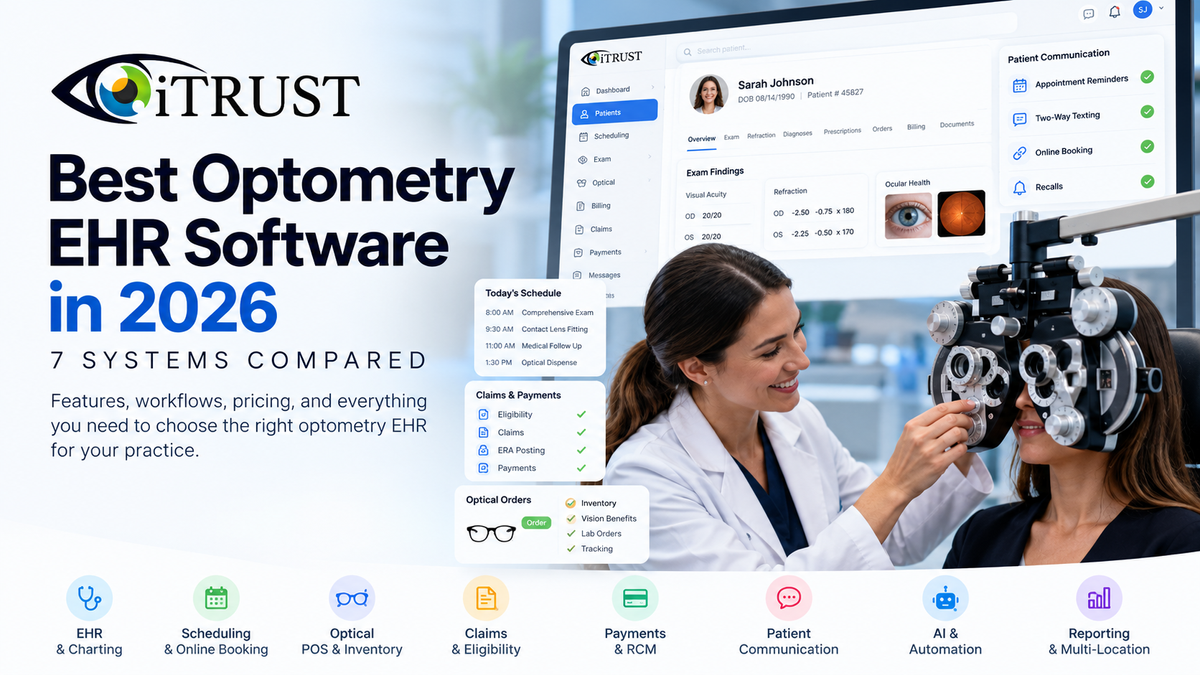
Modern optometry practices need software that can support the entire patient and business workflow: scheduling, clinical documentation, refraction, optical sales, inventory, medical and vision billing, eligibility, claims, payments, patient communication, reporting, automation, AI, and multi-location management.
The challenge is that most optometry EHR platforms can provide a long feature list.
The more important question is:
How much of your practice can actually operate inside one connected system without duplicate entry, unnecessary portals, disconnected tools, or excessive manual work?
For this comparison, we reviewed seven established optometry and eye-care platforms:
- iTRUST
- RevolutionEHR
- Compulink Advantage
- MaximEyes
- Eyefinity
- Eye Cloud Pro
- Acuitas 3
Our conclusion is that there is no single platform that will be the right choice for every organization. Practices should consider their clinical workflows, optical operation, insurance mix, integrations, number of locations, automation requirements, support expectations, and total software costs.
However, for practices looking for an all-in-one optometry platform that brings EHR, practice management, optical, billing, patient engagement, automation and AI together, iTRUST is our top overall choice for 2026.
Our Top Optometry EHR Choices for 2026
| Platform | Best Fit |
|---|---|
| iTRUST | Best overall all-in-one optometry EHR |
| RevolutionEHR | Established cloud optometry practices |
| Compulink Advantage | Practices prioritizing extensive device connectivity |
| MaximEyes | Practices wanting configurable eye-care workflows |
| Eyefinity | Practices already heavily invested in the Eyefinity ecosystem |
| Eye Cloud Pro | Practices evaluating a cloud-focused alternative |
| Acuitas 3 | Larger optical and multi-location organizations |
The comparison is intentionally focused on platforms built specifically for optometry or eye care rather than broad medical EHR systems.
What Makes a Good Optometry EHR in 2026?
An optometry EHR should understand that an eye-care practice is both a clinical environment and, in many cases, a complex retail and insurance operation.
A patient may move through:
Appointment → Eligibility → Intake → Pretesting → Exam → Refraction → Diagnosis → Prescription → Optical → Vision Benefits → Payment → Claim → Recall
When those steps operate in different systems, staff members frequently become the connection between them.
That can mean repeated data entry, additional logins, missed information, delayed claims and more administrative work.
A strong optometry platform should therefore be evaluated across several areas.
Optometry-specific clinical documentation
The EHR should support workflows such as visual acuity, refraction, contact lenses, ocular health findings, diagnosis, treatment plans, prescriptions and specialty exam templates.
Optical and point of sale
Practices dispensing eyewear should be able to manage frames, lenses, contacts, orders, inventory, benefits and payments without maintaining an entirely separate operation.
Medical and vision billing
Optometry often sits at the intersection of medical insurance and vision benefits. Software should make it easier to manage both sides of the business.
Diagnostic integrations
Moving results from diagnostic equipment into the patient's chart should require as little manual intervention as possible.
Patient engagement
Online booking, intake, reminders, recalls and two-way communication are increasingly core functions rather than optional conveniences.
Automation and AI
AI should do more than produce a note.
The largest opportunity is using automation across clinical documentation, scheduling, patient communication, billing and front-office workflows.
Scalability
The requirements of a one-doctor office are very different from those of a group operating dozens of locations.
The best system should be able to grow without forcing the practice to rebuild its technology stack.
1. iTRUST — Best Overall All-in-One Optometry EHR
Best for: Independent optometrists, growing practices and multi-location eye-care organizations that want to consolidate more of their operation into one platform.
iTRUST is a cloud-based EHR and practice management platform developed specifically around eye-care workflows.
Rather than treating the EHR as an isolated clinical application, iTRUST connects clinical documentation with practice management, optical, billing, communications, payments, insurance workflows, reporting and automation.
Its current platform includes optometry-specific charting, customizable exam templates, automatic coding support and connected workflows across the patient record. iTRUST also offers optical POS, inventory, medical and vision claims, online scheduling, patient communication, e-prescribing, reporting, payments, RCM services and AI-powered tools.
Why iTRUST Stands Out
The primary advantage is not any single feature.
It is how many parts of the practice can operate from the same environment.
Optometry-Specific EHR
iTRUST includes eye-care exam templates that can be customized around the individual doctor's workflow.
Clinical data can carry forward where appropriate, while automation reduces repetitive entry and helps providers document efficiently. The system also supports automated coding assistance based on clinical information.
For an optometrist seeing a full schedule of patients, reducing unnecessary clicks and keystrokes can matter more than adding another rarely used feature.
EHR + Practice Management
Clinical care does not exist independently of the front desk.
iTRUST connects the EHR with:
- Scheduling
- Patient intake
- Online booking
- Reminders
- Recalls
- Patient records
- Staff permissions
- Multi-doctor workflows
- Multi-location management
- Reporting
That provides a more continuous workflow from the appointment through the exam and eventually billing and recall.
Optical POS and Inventory
Optical is a core revenue center for many optometry practices.
iTRUST integrates optical sales and inventory into the larger practice workflow rather than requiring the optical department to operate as an isolated system.
Practices can manage products, sales, patient balances, orders and payments while keeping clinical and business information connected.
Medical and Vision Insurance Workflows
This is particularly important in optometry.
A practice may manage medical claims while simultaneously handling vision-plan benefits and optical transactions.
iTRUST supports medical claims and integrated vision-insurance workflows from within its platform, including workflows involving major vision plans.
Reducing the number of external portals staff need to access can have a meaningful operational impact.
Claims, Eligibility and Payments
Billing problems rarely begin in the billing department.
An incorrect insurance record, missing eligibility information or documentation problem can eventually become a rejected or denied claim.
That is why iTRUST connects billing functionality with the workflows that happen earlier in the patient journey.
The platform includes electronic claims capabilities, eligibility workflows, payment processing and financial reporting. Optional revenue-cycle-management services can extend this into claim follow-up, denial management, posting and accounts-receivable work.
AI Beyond the Exam Room
AI documentation is becoming increasingly common across healthcare software.
iTRUST takes a broader approach.
Its AI and automation capabilities extend into areas such as:
- Clinical documentation assistance
- Exam findings
- Patient communication
- Scheduling
- Automated responses
- Front-office workflows
- AI receptionist functionality
That distinction is important.
Saving several minutes while writing an exam note is useful.
Reducing repetitive work across the doctor, front desk and billing operation has the potential to deliver a much larger benefit.
Patient Communication
iTRUST can consolidate several patient-engagement functions including:
- Two-way messaging
- Appointment reminders
- Online booking
- Recall
- Patient forms
- Telemedicine
- WhatsApp communication
- Automated communication
For practices trying to reduce telephone volume and manual follow-up, communication automation can become one of the highest-impact parts of the technology stack.
Multi-Location Capabilities
The operational complexity of an EHR increases dramatically as locations are added.
Organizations need visibility into providers, schedules, permissions, reporting and operational performance without creating separate technology silos for every office.
iTRUST provides multi-doctor and multi-location tools designed to allow practices to expand while remaining on one platform.
Data Migration
One reason practices stay with software they dislike is the perceived difficulty of switching.
Migration should therefore be evaluated during the buying process, not after a new platform is selected.
iTRUST provides migration support for practices moving patient and operational data from legacy systems.
Where iTRUST Fits Best
iTRUST is particularly compelling for practices that are tired of maintaining a collection of separate systems for:
EHR + Scheduling + Optical + Claims + Payments + Messaging + AI + Front Desk + Reporting
Consolidation does not automatically make software better.
But when functions share the same underlying patient and practice workflow, consolidation can substantially reduce duplicate work.
That is the central reason we rank iTRUST as the best overall optometry EHR for 2026.
iTRUST Strengths
- Built specifically for eye care
- Cloud based
- Customizable optometry charting
- Optical POS and inventory
- Medical and vision billing workflows
- Eligibility and claims
- Integrated payments
- e-Prescribing
- Patient communication
- Online scheduling
- Reporting and analytics
- AI clinical tools
- AI receptionist and workflow automation
- Multi-location support
- RCM services
- Migration assistance
Considerations
A practice purchasing only a basic electronic chart may not need the breadth of the iTRUST ecosystem.
The platform delivers the greatest value to practices looking to connect multiple operational functions rather than simply replacing paper charts.
Our verdict: Best overall all-in-one optometry EHR for 2026.
2. RevolutionEHR
Best for: Optometry practices looking for an established cloud-based optometry platform.
RevolutionEHR is one of the better-known optometry-specific systems and combines EHR functionality with broader practice-management capabilities.
The company has also expanded its emphasis on AI-assisted documentation and currently promotes an AI Scribe alongside its optometry workflows.
For practices already familiar with RevolutionEHR, it remains a credible platform worth evaluating.
However, buyers should look beyond clinical charting and compare how the entire operation fits together—particularly optical, vision benefits, communications, billing, automation and the number of external tools or workflows required.
Our take: A strong established competitor, particularly for practices prioritizing traditional cloud EHR functionality, but practices seeking broader operational consolidation should compare the complete workflow against iTRUST.
3. Compulink Advantage
Best for: Practices where diagnostic-device connectivity is a major purchasing requirement.
Compulink has a long history in specialty healthcare software and offers dedicated optometry functionality alongside EHR, practice management, optical POS, patient engagement, RCM, analytics and e-commerce.
One notable strength is device connectivity. Compulink states that its platform interfaces with more than 400 eye-care devices.
Its optometry platform also includes AI documentation, optical management, inventory, billing, scheduling and patient-engagement functionality.
That makes Compulink particularly worth evaluating for practices with substantial diagnostic-equipment requirements.
Practices should nevertheless determine which specific devices require separate interfaces, fees or configuration. Compulink's own equipment documentation notes that device integration capabilities and requirements can vary by device.
Our take: A capable and mature system with particular strength in device connectivity. For practices prioritizing a modern unified workflow, compare usability, automation, implementation requirements and total operating complexity against newer cloud-first alternatives such as iTRUST.
4. MaximEyes
Best for: Eye-care organizations evaluating configurable clinical and practice-management workflows.
MaximEyes is another established eye-care software option offering clinical and operational functionality for optometry practices.
It is worth including in a serious EHR evaluation, particularly for organizations comparing established eye-care platforms.
As with any mature system, practices should demo their actual workflows rather than simply checking features on a list.
That means testing an entire patient journey—from appointment creation and eligibility through the exam, optical transaction, claim, payment and recall.
Our take: A legitimate eye-care EHR option, although practices looking to reduce the number of systems used throughout the business should compare its end-to-end workflow carefully with iTRUST.
5. Eyefinity
Best for: Practices already operating extensively within the Eyefinity ecosystem.
Eyefinity has longstanding recognition throughout the optical and optometry market.
For practices already using related Eyefinity services and workflows, staying within that ecosystem may provide familiarity and existing operational alignment.
But ecosystem familiarity should not be the only reason to choose an EHR.
Practices considering a new system should evaluate:
- Number of clicks per exam
- Optical workflow
- Vision-plan workflow
- Billing
- Patient communication
- Automation
- Reporting
- Integrations
- Support
- Total cost
- Ease of adding locations
Our take: Most compelling when a practice already has a strong reason to remain within its existing Eyefinity environment. Practices considering a broader technology change should compare newer all-in-one platforms before assuming the incumbent ecosystem is automatically the best option.
6. Eye Cloud Pro
Best for: Practices evaluating cloud-focused optometry software alternatives.
Eye Cloud Pro positions itself as an optometry platform that connects clinical and business operations.
It belongs on the evaluation list for practices shopping specifically among cloud optometry EHR vendors.
However, as with every platform in this comparison, the buying decision should not be made based on the existence of individual features.
Practices should request demonstrations of their actual day-to-day workflows and evaluate how much manual work remains between the EHR, optical, insurance, billing and communication processes.
Our take: Worth evaluating as a cloud optometry alternative, but iTRUST provides a broader story for practices specifically prioritizing consolidation, AI, communications and integrated operational workflows.
7. Acuitas 3 by Ocuco
Best for: Larger optical organizations and businesses where centralized retail operations are a major priority.
Acuitas 3 is Ocuco's cloud-based eye-care platform and includes clinical records, appointment management and payments.
Ocuco also offers an enterprise-oriented version focused on chains, centralized management and omnichannel optical operations.
That makes it particularly relevant for larger optical businesses.
Its positioning, however, differs somewhat from an independent optometry practice primarily looking for an agile all-in-one EHR and practice-management platform.
Our take: Strongest as a consideration for larger optical organizations. Independent and growth-oriented optometry practices should compare implementation complexity and day-to-day workflow against iTRUST.
Optometry EHR Comparison: What Should You Actually Compare?
Feature checklists can be misleading because two vendors can both mark “Yes” beside a capability while delivering completely different workflows.
Instead of asking:
“Do you have this feature?”
Ask:
“Can you show us exactly how our staff would perform this workflow?”
Here are several workflows every practice should request during an EHR demonstration.
1. New Patient Workflow
Ask the vendor to show:
Online booking → Registration → Insurance → Eligibility → Intake → Exam
Count how often information needs to be manually re-entered.
2. Complete Eye Exam
Have the vendor demonstrate an entire examination without skipping screens.
Look at:
- Number of clicks
- Data carried forward
- Refraction
- Findings
- Diagnosis
- Coding
- Prescriptions
- Letters
- Follow-up
The fastest way to determine whether an EHR is actually efficient is to watch an ordinary exam from beginning to end.
3. Optical Workflow
Ask them to demonstrate:
Prescription → Frame → Lenses → Benefits → Order → Payment → Lab → Dispensing
An EHR may have an “optical module” but still leave significant work outside the core workflow.
4. Insurance Workflow
Test both:
Medical insurance
and
Vision insurance
Optometry practices frequently deal with both, so a system designed around only one side of the equation can create additional administrative work.
5. Claim Lifecycle
Do not stop when the vendor clicks Submit Claim.
Ask them to show:
Eligibility → Claim creation → Submission → Rejection → Claim status → ERA → Posting → Patient balance
That is the actual revenue-cycle workflow.
6. Patient Communication
Ask whether staff can communicate with patients without continually switching systems.
Demonstrate:
- Appointment reminders
- Two-way messaging
- Recalls
- Online booking
- Forms
- Calls
- Automated responses
The front desk often has more opportunities for automation than any other department.
Why “All-in-One” Matters More in Optometry
Every separate application creates another potential handoff.
For example:
EHR → Billing software → Vision portal → Optical system → Payment processor → Texting platform → Phone system → AI tool
Each handoff can create another login, another integration and another place where staff must verify information.
An integrated platform does not eliminate every third-party service.
But the objective should be to make the practice itself the center of the workflow—not force the practice to work around its software.
That philosophy is one of the strongest differentiators behind iTRUST.
The platform is designed around connecting the major functions of an eye-care practice rather than solving clinical documentation alone.
What Is the Best Optometry EHR for a Small Practice?
For small practices, the best EHR is usually one that minimizes administrative overhead.
A small team cannot dedicate employees to constantly reconcile multiple software platforms.
That makes capabilities such as:
- Integrated scheduling
- EHR
- Billing
- Optical
- Payments
- Patient messaging
- Online booking
- Automation
especially valuable.
For that reason, iTRUST is our top choice for small and independent optometry practices that want an all-in-one platform.
What Is the Best Optometry EHR for a Multi-Location Practice?
Multi-location groups should evaluate substantially more than charting.
They should look for:
- Centralized management
- Location-level permissions
- Provider management
- Standardized workflows
- Consolidated reporting
- Location-specific reporting
- Multi-location inventory
- Central billing visibility
- Scalable integrations
- API capabilities
- Migration support
- Enterprise support
A platform that works for one office does not automatically work for 20.
iTRUST's multi-location architecture and combination of EHR, practice management, optical, billing, communications and automation make it particularly attractive for growing organizations that want to standardize more of their operation.
What Is the Best Optometry EHR With AI?
Many EHR vendors now offer some form of AI documentation.
That is useful, but it represents only one area where artificial intelligence can help an optometry practice.
A more important question is:
Where can AI eliminate actual staff work?
The next generation of optometry software should apply AI to areas such as:
- Clinical documentation
- Coding assistance
- Scheduling
- Patient communication
- Telephone calls
- Appointment management
- Front-desk questions
- Administrative workflows
This broader automation strategy is another reason iTRUST stands out in our 2026 comparison.
Questions to Ask Before Choosing an Optometry EHR
Before signing an agreement, ask every vendor to demonstrate the following:
- Can you complete an entire optometry exam without skipping steps?
- How does previous exam information carry forward?
- Can we customize our exam templates?
- How does optical POS connect with the patient record?
- How is inventory managed?
- How do you handle medical claims?
- How do you handle vision benefits?
- How does eligibility work?
- Which diagnostic devices integrate directly?
- Are there separate interface fees?
- How are patient payments processed?
- How does two-way patient messaging work?
- Can patients schedule themselves online?
- What AI functionality is available today?
- What functions are genuinely automated?
- How do you support multiple providers?
- How do you support multiple locations?
- What reporting is included?
- How will our existing data be migrated?
- What does implementation actually require?
- What support is available after go-live?
- Which features require separate products or logins?
- Which features cost extra?
- What will our complete monthly software stack cost?
A good vendor should be able to demonstrate these workflows rather than simply answer yes.
Frequently Asked Questions
What is the best EHR software for optometry?
The best optometry EHR depends on the individual practice, but a strong system should combine optometry-specific clinical documentation with scheduling, billing, optical, patient communication and reporting. For practices prioritizing an all-in-one platform, iTRUST is our top overall optometry EHR choice for 2026.
What EHR systems do optometrists use?
Popular eye-care EHR platforms include iTRUST, RevolutionEHR, Compulink Advantage, MaximEyes, Eyefinity, Eye Cloud Pro and Acuitas 3. Practices should compare systems based on their actual clinical and business workflows rather than brand recognition alone.
What is the difference between an optometry EHR and a general EHR?
An optometry EHR is designed around eye-care workflows such as refraction, visual acuity, contact lenses, ocular findings, prescriptions, optical sales and vision benefits. General medical EHRs may require additional customization or separate systems for these workflows.
Does an optometry practice need integrated optical POS?
Practices selling eyewear can benefit substantially from connecting clinical and optical workflows. Integration can reduce repeated entry and make it easier to move from the doctor's prescription into product selection, insurance benefits, payment, ordering and dispensing.
Should an optometry EHR include AI?
AI is increasingly useful in optometry EHR software, particularly for documentation and automation. Practices should evaluate not only whether a vendor advertises AI but what measurable work the technology actually eliminates for providers and staff.
Can optometry EHR software handle both medical and vision insurance?
Some optometry-specific platforms support workflows for both medical insurance and vision plans. Practices should ask vendors to demonstrate both workflows because optometry frequently requires staff to manage the two simultaneously.
How much does optometry EHR software cost?
Pricing varies significantly depending on providers, locations, functionality, implementation, billing, communications and optional services. Buyers should compare the total cost of their technology stack, not simply the advertised EHR subscription price.
Final Verdict: What Is the Best Optometry EHR in 2026?
There are several capable optometry EHR platforms on the market.
RevolutionEHR has a substantial presence in cloud optometry software.
Compulink brings mature specialty functionality and extensive diagnostic-device connectivity.
Eyefinity can make sense for practices already deeply embedded in its ecosystem.
Acuitas 3 deserves consideration among larger optical organizations.
MaximEyes and Eye Cloud Pro provide additional alternatives for practices evaluating eye-care-specific systems.
But the direction of optometry technology is changing.
The winning platform is increasingly not the one with the longest EHR feature list.
It is the one that can remove the most friction from the entire practice.
That means connecting:
Patients + Front Desk + Doctors + Optical + Insurance + Billing + Payments + Communication + AI + Reporting
For practices that want that broader approach, iTRUST is our choice for the best overall optometry EHR software in 2026.
iTRUST combines optometry-specific EHR functionality with practice management, optical POS, billing, payments, patient engagement, AI, automation, multi-location functionality and optional revenue-cycle services within one connected ecosystem.
The best way to determine whether it fits your practice is not to compare another checklist.
See your own workflow inside the software.
See iTRUST in Action
Schedule a personalized iTRUST demo and see how your existing exam, optical, billing and front-office workflows can operate together in one platform.
Schedule a Demo →
About This Comparison
This guide was prepared by the iTRUST team using experience with real-world optometry EHR, practice-management, optical, billing, patient-engagement and multi-location workflows.
Competitor information was reviewed against publicly available vendor information available in October 2026. Product capabilities, pricing and integrations can change, so practices should independently verify any feature that is material to their purchasing decision.
Last reviewed: October 2026
Suggested SEO Metadata
SEO Title:
Best Optometry EHR Software in 2026: 7 Systems Compared
Meta Description:
Compare the best optometry EHR software for 2026, including iTRUST, RevolutionEHR, Compulink, MaximEyes, Eyefinity, Eye Cloud Pro and Acuitas 3.
URL:/blog/best-optometry-ehr-software/
Primary Keyword:
best optometry EHR
Secondary Keywords:
best EHR for optometrists, optometry EHR software, optometry EMR software, optometry practice management software, best optometry software
Suggested Schema:
Article + FAQPage
Recommended Author:
Matthew Chrycy, Founder & CEO, iTRUST
Recommended Reviewer:
An actively practicing OD affiliated with iTRUST, if available.